← BlogMarch 30, 2026AI · Governance · Security · Compliance · Zero Trust · GRC

AI Governance Without Teeth Is Just Theatre

Why most AI governance is a PDF nobody reads, and what operational governance — enforcement gates, AI inventories, zero trust for agents, and prompt injection playbooks — looks like in practice.
Most AI governance programs are PDFs that make executives feel better. They get written, approved, filed away, and forgotten. Meanwhile, engineering teams ship LLM features with zero guardrails because nobody built enforcement into the system. That's not governance. That's liability with better branding. If you're building or deploying AI in 2026, the real question isn't whether you have a policy. It's whether that policy changes what happens in production. If it doesn't change decisions, block releases, or trigger response, it's theatre.
We don't have a shortage of AI governance frameworks. We have an implementation problem. The EU AI Act now has real enforcement machinery. NIST AI RMF gives practical risk management structure. ISO/IEC 42001 offers a certifiable AI management system. That should be enough. But in too many organisations, the pattern repeats: download a framework, map it to a spreadsheet, assign overloaded owners, call it done. The result looks mature on paper and does almost nothing in practice.
Governance only matters if someone can say no. A specific person or team must have authority to block a deployment, pause a model, or shut down an AI pipeline when risk crosses the line. If your AI ethics board is advisory only, it's optional. Optional governance gets ignored when revenue pressure hits. This is where most programs fail:
  • Policies exist, but no gates enforce them.
  • Standards written, but no kill switch deployed.
  • Risk registers maintained, but no operational ownership assigned.
  • Review boards convened, but no consequences attached.
A governance model without enforcement is a suggestion box.
A generic policy like "we will use AI responsibly" is useless because AI risk isn't generic. You need to know:
  • Which models run in production.
  • Which data flows through them.
  • Which outputs reach customers or employees.
  • Which actions the system can execute.
  • Who answers when it fails.
That's table stakes. If you can't answer those five questions, you don't have governance. You have exposure. Shadow AI makes this harder. Employees already use unsanctioned tools, browser models, copilots, third-party integrations that security never approved. No inventory, no governance.
Prompt injection is the AI equivalent of SQL injection in the 90s. We built powerful systems without input sanitisation — then spent decades cleaning up. Now LLMs face the same flaw, but the blast radius is bigger: models reason, act, chain tools. Governance can't just ask, "Is the model accurate?" It must also address:
  • Can untrusted input hijack system behaviour?
  • Can the model reach tools or APIs it shouldn't?
  • Can a compromised session leak data or trigger actions?
  • Can we trace and stop damage fast?
If your framework ignores prompt injection, it's already obsolete.
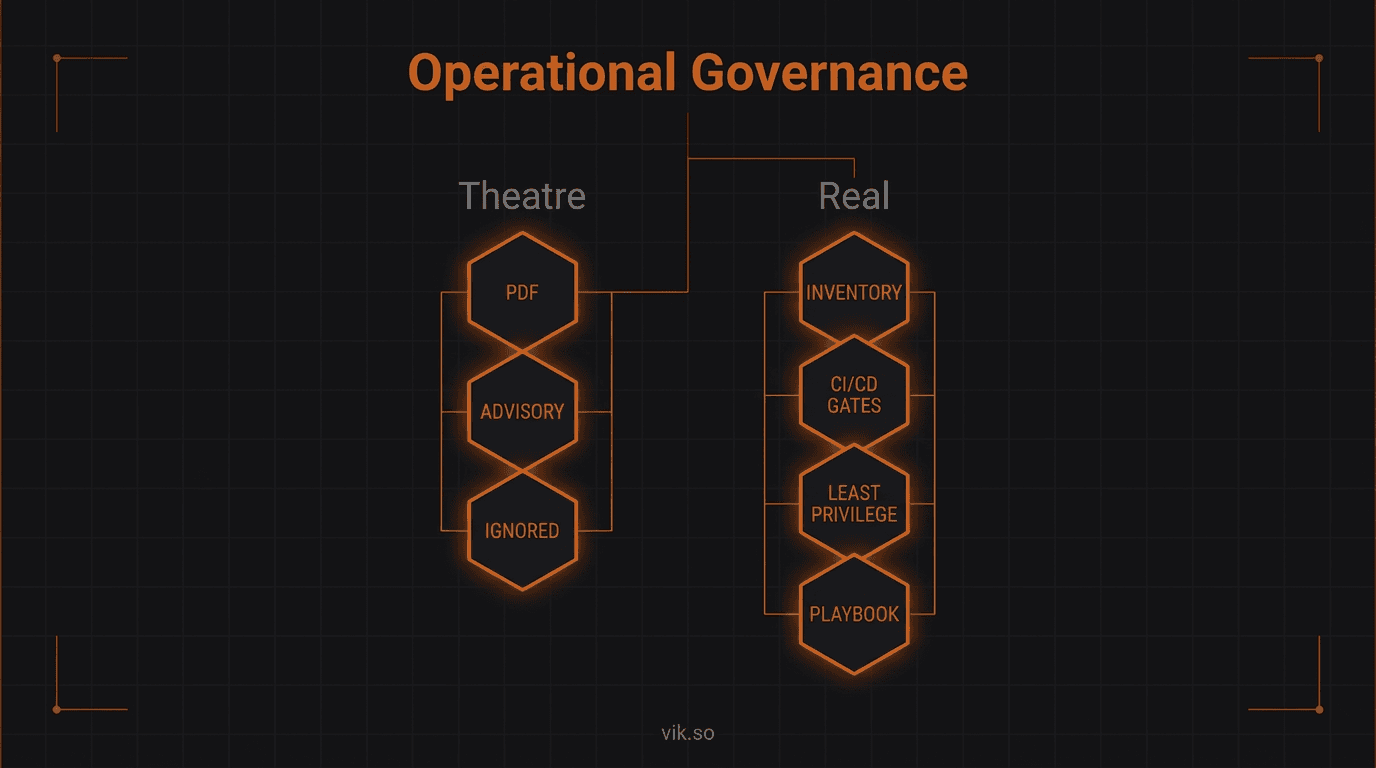
Theatre vs Real governance — what operational AI governance actually requires
Don't give an LLM agent broad permissions any more than you'd hand root access to an untrusted contractor. AI agents must be:
  • Authenticated — identity verified.
  • Authorised with least privilege — tightly scoped.
  • Logged comprehensively — every action visible.
  • Contained by default — blast radius limited.
You can't govern what you can't see. You can't contain what you can't limit. AI governance belongs inside security architecture, not as a parallel ethics exercise. This maps cleanly to existing zero trust architectures. If you're running NIST CSF, your PR.AA (Access Control) and DE.CM (Continuous Monitoring) categories absolutely apply to AI agents — most orgs just haven't made that connection explicit. The Control Mesh on vik.so visualises exactly where these cross-framework mappings land.
Good AI governance feels boring — in the best way. It delivers:
  • Live AI inventory, auto-updating from pipelines.
  • Named owners per system, personally accountable.
  • Automated gates for high-risk deployments.
  • Routine red teaming, adversarial testing.
  • Logging, monitoring, rollback that works.
  • AI-specific incident playbooks.
Govern, map, measure, manage — not aspirational, operational.
Slow detection and response extends every AI incident's blast radius. AI moves fast; governance must move faster. Annual reviews made sense for static systems. AI drifts — models update, prompts tweak, data shifts, permissions creep. Continuous evaluation beats ceremonial check-ins.
Too much AI governance reassures boards, satisfies procurement, calms auditors. Fine goals, but if it doesn't change engineering behaviour, it's not governance. The winners won't have the prettiest PDFs. They'll embed governance into architecture, deployment, monitoring, response — from day one. Stop asking if your governance looks mature. Ask if it can:
  • Block a bad deployment.
  • Catch bad output.
  • Shut down a rogue agent.
That's the only test that matters.
I've spent years at the intersection of product security, compliance, and shipping AI tools. Governance isn't a document problem. It's engineering and organisational design. If you're struggling with the control mapping piece — figuring out where ISO 27001, NIST CSF, and AI-specific requirements overlap — that's what I built vik.so to solve. The ISO 27001 Navigator and NIST CSF Navigator help you work through controls with AI that actually understands the standards. What does yours enforce today — not what's written, what's real?